


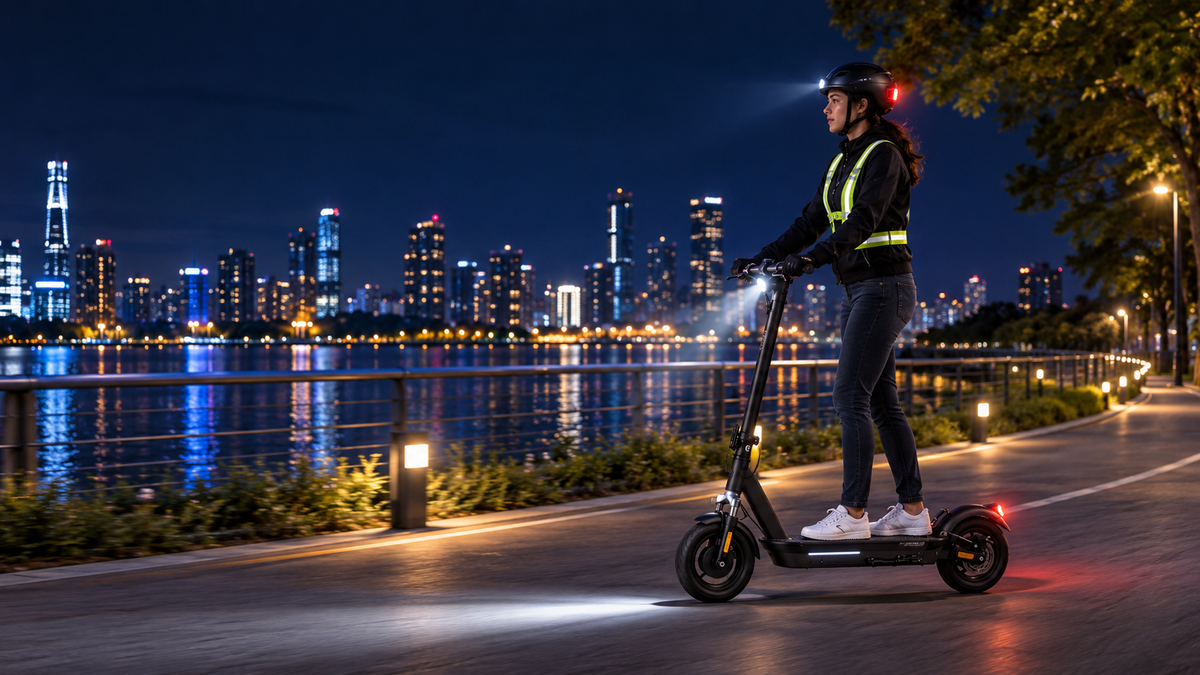
Introduction
Although you can ride an electric scooter safely at night, it requires more preparation than just heading out after dark and hoping for the best.
Darkness changes the equation in ways that matter. Drivers see less, react more slowly, and small vehicles like scooters are genuinely harder to spot than larger ones. The riders who get through night commutes without incident aren't just lucky because they've made themselves visible, adjusted how they ride, and thought about their route before leaving. This guide covers exactly that.
Why Night Riding Demands More from You
Visibility Drops for Everyone
It's not just about whether you can see the road. Drivers at night have reduced depth perception, weaker peripheral vision, and less ability to distinguish detail at a distance. Even on a well-lit street, a small dark scooter blends into the background in a way that a car or truck doesn't. You can see them fine, but the problem is whether they can see you.
Reaction Time Gets Worse
Low light conditions slow down hazard recognition for everyone on the road. Drivers brake later. You notice obstacles more slowly. The gap between seeing something and responding to it widens, which means the margin for error shrinks. A few extra seconds of warning, which better visibility buys you, is genuinely meaningful at 20–25 km/h.
Road Hazards Hide Better in the Dark
Potholes, wet patches, debris, and uneven surfaces are harder to detect at night, even with a headlight. Electric scooters are more sensitive to road imperfections than bicycles because of their smaller wheels, so a hazard you'd roll over comfortably on a bike can cause a real problem on a scooter. Slower speed and better lighting are the practical responses.
Lighting: Your First and Most Important Defense
Front Headlight
Most scooters come with a built-in headlight, but built-in doesn't automatically mean adequate. A useful headlight illuminates several meters ahead with a wide beam rather than a narrow spot, and stays steady without flickering at speed or over bumps. If your stock light feels weak in practice, a secondary clip-on light is an easy and inexpensive addition. Being able to see what's ahead matters as much as being seen by others.
Rear Light
Most nighttime collisions involving cyclists and scooter riders happen from behind, which makes the rear light arguably more critical than the front. It needs to be clearly visible from a meaningful distance, positioned at a height drivers can easily see, and not blocked by a bag or jacket. A steady red light or a slow pulse both work; only erratic strobe patterns are actually harder to process for approaching drivers.
Side Visibility
Side visibility is the one most riders forget about entirely. A driver approaching from a cross street sees neither your front nor rear light; they see your profile, which, on a dark scooter with dark clothing, is close to nothing. Reflective strips on the wheels, reflective tape along the deck edge, or clothing with side-facing reflective panels all help with this. Intersections are where a lot of night riding incidents happen, and side visibility is specifically what protects you there.
Reflective Gear: What Actually Makes You Visible
Lights make you visible from the front and rear. Reflective materials work from every angle by bouncing car headlights back toward the driver.
Reflective Vest or Jacket
A reflective vest worn over regular clothing is lightweight, cheap, and one of the most effective visibility upgrades available. It outlines your body shape, which reads immediately as a person to other road users, and reflects headlights from well ahead of where a driver might otherwise notice you. Neon yellow and orange also help in conditions where there's some ambient light.
Reflective Helmet
Your helmet sits at the highest point of your silhouette and is often the first part of you that a driver's headlights reach. A helmet with reflective strips or integrated rear lighting adds visibility at exactly the right height and angle. It doesn't need to be elaborate. But even small reflective details on an otherwise dark helmet make a difference.
Reflective Bands for Arms and Legs
Moving reflective elements are more attention-grabbing than static ones. Reflective ankle bands or wrist bands catch headlights as you move, creating a visual pattern that registers faster in a driver's peripheral vision than a fixed reflector. The motion signals immediately that you're a person in a vehicle, not a road sign or parked object.
How to Adjust Your Riding at Night
Gear handles visibility. Your behavior handles the rest.
Slow Down
Lower speed gives you more time to react to what your headlight reveals and more time for drivers to respond to you. The appropriate reduction depends on how well-lit your route is and how familiar you are with it. It’s important to be more careful on an unlit road you've never ridden at night because it warrants more caution than a familiar, well-lit commute. The principle is the same either way: speed that's appropriate in daylight is often too fast after dark.
Increase Following Distance
More space between you and the vehicle ahead means more time to react if they brake suddenly, and better visibility of the road surface ahead of them. The following distance that feels comfortable during the day should roughly double at night.
Stay Out of Blind Spots
Never assume a driver has seen you. If you can't see the driver's face in their side mirror, they can't see you in it either. Staying clearly visible in mirrors, positioning yourself ahead of or clearly behind vehicles rather than alongside them, and not lingering in the side zones where large vehicles have no visibility all reduce the chance of a collision caused by someone simply not knowing you were there.
Choosing the Right Route at Night
The route that works fine during the day isn't always the best one after dark.
Prioritize Well-Lit Streets
A slightly longer route on well-lit roads is safer than a shorter one through poorly lit areas. Streetlights help you see, and they help drivers see you significantly sooner, which increases the reaction time available if anything goes wrong.
Use Bike Lanes
Dedicated lanes for bikes and scooters separate you from moving traffic, which reduces the variables you're managing at any given moment. Check that the lane itself is in decent condition. Other bike lanes that are poorly maintained or run through a very dark stretch introduce their own risks.
Avoid High-Speed Roads
Fast-moving traffic and small scooters at night are a combination worth avoiding. Drivers traveling at higher speeds have less time to process and react to a scooter, and the consequences of an error are worse. Routes with moderate speed limits and predictable traffic flow are the right choice after dark.
Weather and Night Riding
Wet pavement at night creates glare from streetlights and headlights that can actually make it harder to see the road surface clearly. It also makes surfaces more slippery than they appear, so you need to brake gently and avoid sharp directional changes. Moreover, the combination of reduced visibility and reduced traction is unforgiving of sudden inputs.
Fog and mist are the conditions that most warrant reconsidering the ride entirely. When visibility drops to the point where your lights aren't helping much, slowing down significantly is the minimum response. If conditions are genuinely bad, postponing the ride is the right call.
Battery and Power Awareness at Night
Lights draw power from the same battery that moves you. Before a night ride, check both your battery level and your estimated remaining range. Problems such as losing lights mid-commute are a problem that's easy to prevent and genuinely dangerous if it happens. A small rechargeable backup light that clips to your bag or helmet is cheap insurance against a main light failure.
Mental Focus After Dark
Riding at night isn't the time for divided attention. Keep audio at a level where you can hear approaching vehicles; sometimes your ears compensate for reduced visual information in ways you don't fully appreciate until you block them out. Phones and other distractions are always a bad idea on a scooter, but at night, the cost of a moment's inattention is higher.
Expect drivers to behave less predictably than during the day. Late braking, unexpected turns, and misjudgments of your speed are all more common in low-light conditions. Riding defensively, anticipating what drivers might do rather than what they should do, is the mental habit that keeps night riding safe over time.
Conclusion
Night riding on an electric scooter is safe when you prepare for it properly. Strong front and rear lights, reflective gear, a well-chosen route, and a riding style that accounts for reduced visibility all work together to keep the risk manageable.
The core principle is straightforward: see what's ahead of you, make sure others can see you, and ride in a way that gives everyone on the road enough time to react. Do those three things consistently, and night commuting becomes a normal part of your routine rather than something that feels risky.
What They Usually Ask
Is it safe to ride an electric scooter at night?
Yes, with proper preparation. Adequate lighting, reflective gear, reduced speed, and smart route choices make night riding manageable. Without those things, the risk increases significantly.
Do I need extra lights if my scooter already has built-in ones?
Depends on how bright they are. Many stock lights are adequate for being seen, but not bright enough to illuminate the road well at speed. If the built-in light feels weak or has a narrow beam, adding a secondary front light is a worthwhile upgrade.
What clothing is best for night riding?
Reflective or high-visibility clothing makes the biggest difference. A reflective vest over regular clothes, reflective ankle or wrist bands, and a helmet with reflective elements cover most of what matters. All-black clothing at night is genuinely dangerous, regardless of how good your scooter's lights are.
Should I ride slower at night?
Yes. Reduced visibility means less time to react to hazards, and less time for drivers to react to you. The appropriate speed depends on how well-lit your route is, but slower is consistently safer after dark.
Are bike lanes safer at night?
Generally, yes, because they separate you from moving traffic. The caveat is that a poorly maintained or poorly lit bike lane introduces its own hazards. Assess the specific lane rather than assuming all bike and scooter infrastructure is equally safe at night.